Showing posts with label Learning. Show all posts

Monday, 30 March 2015

Week 43: Nettle Pesto


Picking a mixture of nettles - just the young tops and if you grasp firmly they don't sting ... apparently and wild garlic.


Same ingredients as last time - nuts and cheese mixed in with the nettles - lightly blanched before chopping finely.  We also sampled fresh nettle tea and pastry parcels made with nettles and cheese. 

It can basically be used like spinach and is incredibly good for you.


Ta dah!

Sunday, 22 March 2015

Week 41: Wild Garlic Workshop

English: Wild garlic See 844871.

Run by the lovely ladies at @PickItCookIt near Ashurst and the first of two workshops I've booked up.

Also known as Ransoms, wild garlic is one of the Spring plants that you can't miss when you come across them, due to their strong, pungent aroma.  They're found in woodland, often along stream and river banks.


After coffee and scones ... containing wild garlic ... on arrival - we head out to pick the wild garlic from the wooded area on the farm, alongside the stream.  On the way back we drop by the veg patch to pick a few leeks and then back to the outdoor workspace to put together pesto.

Pretty easy to make:  Finally chop the greenery - wild garlic and leek or onion if you prefer then mix roughly 2 parts greenery to 1 part grated hard cheese + 1 part crushed nuts - whatever you prefer, walnuts, hazel, almonds.  Add seasoning and spices to taste, mix with a good virgin olive oil or rapeseed to a paste.  Whatever combination and as rough or finely chopped as you like.

Tastes delicious on bread, with pasta or mixed in with pretty much anything.  It got added to pretty much everything I was cooking that week!


Wild garlic (Photo credit: Wikipedia)

Thursday, 22 January 2015

Week 33: RSPB Brighton Group - Urban Birder Talk

House Sparrow, a bird of urban areas which was...
House Sparrow, a bird of urban areas.
A great talk from David Lindo the @Urbanbirder at the Brighton RSPB local group meeting.

Birds are all around us and just because you live in a town or city doesn't mean you can't watch birds.  The popularity of the RSPB's Big Garden Birdwatch shows how many birds you can see in your own garden.

Birds see our green and brown spaces and abandoned buildings as habitat, where they can rest and refuel while on migration, feed and even nest and breed.

David has travelled around the world and in all the urban areas he's visited he manages to find surprising birds in the most unusual places.

The majority of people are totally oblivious to the wildlife right on their doorstep.

#Look Up

(Photo credit: Wikipedia)


Saturday, 22 November 2014

Week 24: Learn a Language - Parlo Italiano

English: The Rosetta Stone in the British Muse...
While I'm not expecting to learn a language in a week I can at least make a start.

Italian is a language I've always wanted to learn, it has a lovely sound to it.  I can manage a few words - just the basics like hello, goodbye, please and thank you and there are many Italian words we're already familiar with, even if it's only from our local Italian restaurant.

The internet has made it easier to learn a language - a few years ago we had were limited to books and audio-tapes, now we have access to the multi-cultural internet:
  • Get translations using Babelfish - often more amusing than accurate
  • Access and download any number of podcasts to help you learn a new language
  • Install language learning apps like Busuu or Rosetta Stone.
  • Listen to foreign language radio
  • Download foreign language films or watch online TV
  • Access learning websites like www.bbc.co.uk/languages (mostly archived but still useful) or DuoLingo.
Many languages have similar roots (like Latin or German), making it easier to pick up or understand words and phrases.  Grammar may take a little more time as, unlike English, they use masculine and feminine forms for nouns and adjectives.  Verbs take different forms depending on 'who' is taking action.

You don't need to be fluent but being able to speak a few basic phrases helps when visiting another country.

The Rosetta Stone in the British Museum. (Photo credit: Wikipedia)

Sunday, 13 July 2014

Week 5: Flora, Fauna and Football

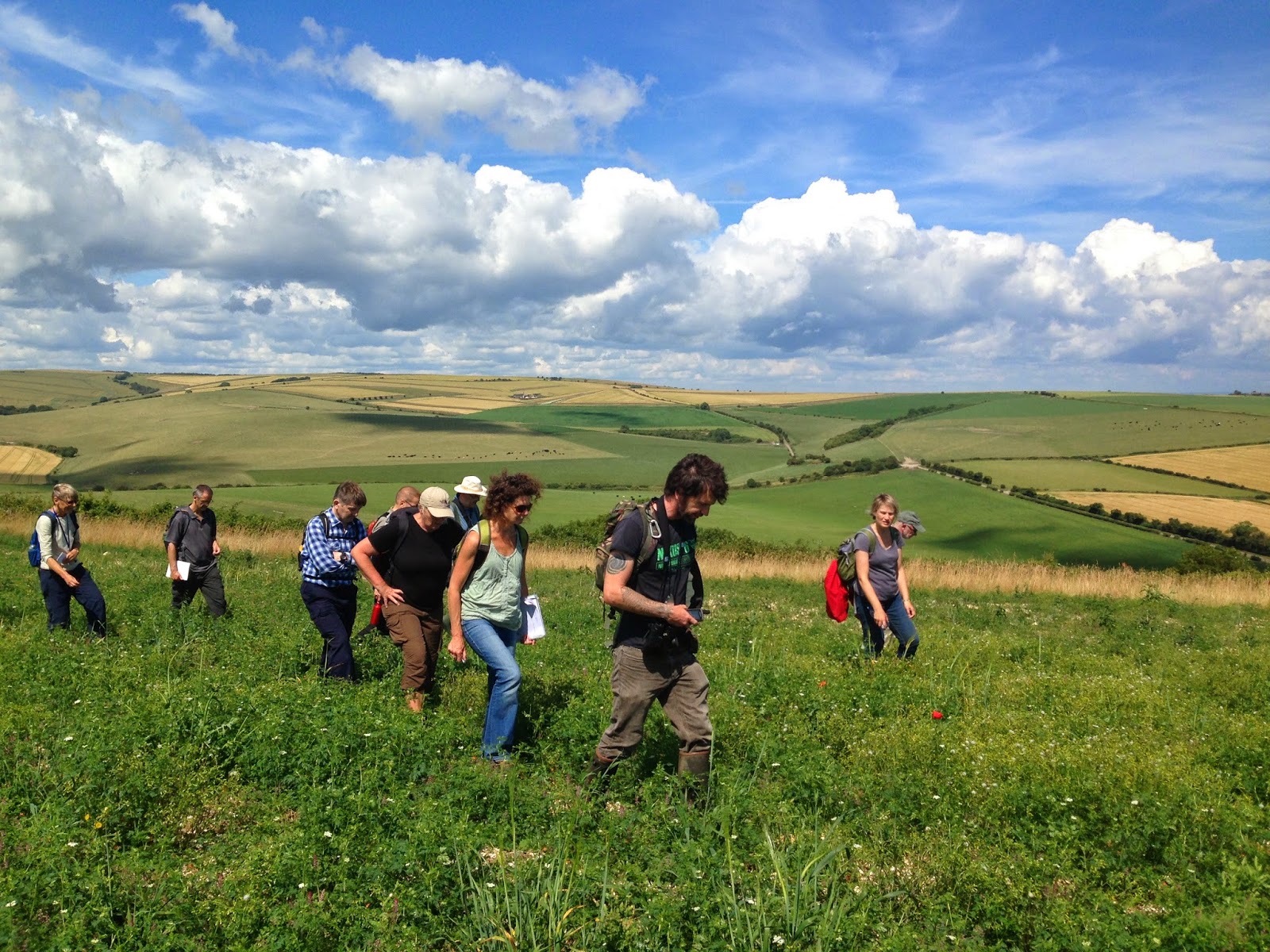
A workshop run by the Sussex Wildlife Trust for the South Downs volunteers on identification of chalk grassland plants and many other things besides from the hugely knowledgeable Graeme Lyons.

First a talk on the ecology of the South Downs and the different communities of plants that we're likely to find, then out into the fresh air and slowly developing sunshine for hands-on, practical plant identification.


Plenty to see just outside the barn in the ungrazed area with a wide variety of wildflowers, butterflies and insects buzzing around.


Venturing further afield we quickly came across some of the communities on grazed land, different heights, different species, different grazing livestock.


A lunch break on the side of the hill - in what shade there was


35 species identified - although that wasn't everything we saw, just those I'd made a note of.  Not to mention the butterflies and a pair of grey partridge who flew up from an area of arable land.


We also got to see an impressive display of pyramid orchids in the fields near to the woodland area, which is slowly being coppiced, rides created and additional planting in what was once a forestry plantation to create a greater diversity of plants and insects.

... and the football?

Well it also happened to be the World Cup Final that evening.  Not something I'd usually elect to watch but I'd been invited over to watch the game with friends and for food and nibbles.

Not having watched any of the other games, I had no particular affiliation with either team.  Good game though - even to a non-footballing observer.

Check out your local Wildlife Trust and see what courses they're running.  They offer a wide variety on diverse topics from arts and crafts to wildlife gardening.